
Writing Strategies
Free TOEFL Integrated Writing Practice: 2026 Alternatives and Practice Plan
Quick Answer
If you searched for TOEFL integrated writing practice free, you are probably looking for source-based writing drills: read a passage, listen to a lecture, then explain how the ideas connect. Those drills are still useful for building core TOEFL writing skills, but your practice should also match the current Reach120 flow.
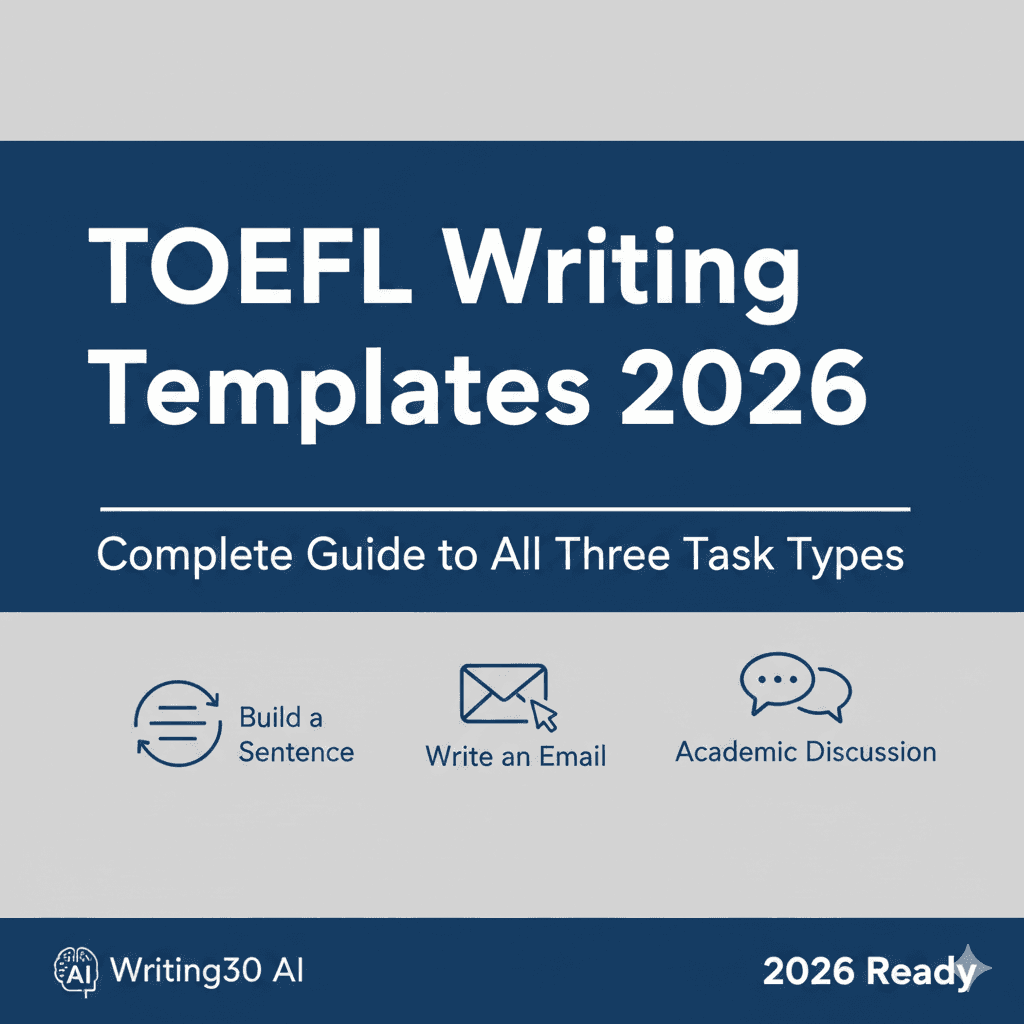
On Reach120, focus your weekly practice around Build a Sentence, Write an Email, and Academic Discussion. Use older integrated-writing material as support training for note-taking, paraphrasing, and evidence selection rather than as your only writing plan.
What to Practice in 2026
A strong TOEFL writing routine should cover three skill layers: sentence accuracy, task completion, and academic explanation. That is why one old integrated-writing template is not enough.
- Build a Sentence: practice arranging 6-12 words into a grammatically correct sentence. This trains the accuracy that supports every longer response.
- Write an Email: practice 80-120 word replies with clear purpose, appropriate tone, and complete response to the situation.
- Academic Discussion: practice 100-150 word responses that state a view, support it, and connect respectfully to other ideas.
For the full format breakdown, use the TOEFL Writing Practice 2026 guide.
Try it — write one response and have it scored
A real prompt from the question bank, scored by the same automated rater a signed-in learner gets. No account, no card, no email.
Discussion Topic
Remote Work in Modern Society
This discussion explores the growing trend of remote work and its impact on both individual employees and organizations.
Professor's Question
Many companies now offer remote work options to their employees. Do you think remote work is beneficial or harmful to employee productivity and well-being? Support your opinion with reasons and examples.
No account, no card, no email. One scored response per day. Scores are produced by an automated rater against the ETS rubric and are Reach120 estimates, not official ETS scores.
Free Practice Plan
Use this plan if you want free practice without wasting time on random prompts. Keep each session short enough that you can review the answer immediately.
- 10 minutes: choose one short academic topic and write five key vocabulary items.
- 6 minutes: complete two Build a Sentence drills using the same vocabulary.
- 7 minutes: write one email related to the topic, such as requesting clarification or explaining a scheduling problem.
- 10 minutes: write one Academic Discussion response with a clear opinion and one specific example.
- 7 minutes: review the response against the rubric and rewrite the weakest two sentences.
You can run this routine from the Reach120 practice page and compare your response quality with the TOEFL writing rubric guide.
Adapt Old Integrated Drills
Old integrated-writing prompts can still be useful if you convert them into modern practice tasks. The goal is not to memorize an old format. The goal is to extract the transferable skills.
- Reading plus lecture notes
- Turn the notes into an Academic Discussion response of at least 100 words (target 100-150). State which source is more convincing and explain why.
- Long integrated-writing sample answers
- Shorten them into email-length paragraphs. This trains clear, direct writing instead of overlong template language.
- Vocabulary lists from lectures
- Use the words in Build a Sentence drills so grammar accuracy improves alongside topic knowledge.
Review Checklist
After each practice session, check the answer before moving on to a new prompt.
- Did I answer the exact task, not just write about the general topic?
- Is the main idea clear in the first sentence?
- Did I use one specific example or reason instead of vague advice?
- Are the sentences controlled, or did I create avoidable grammar errors?
- Would the tone fit the task: email, sentence-building, or academic discussion?
To see model responses and common patterns, browse the Reach120 sample answers.
FAQ
Where can I get TOEFL integrated writing practice free?
Use free academic readings, lecture summaries, and Reach120 practice tasks. The best routine is not one old prompt type repeated endlessly; it is a mix of sentence accuracy, email writing, and academic response practice.
Should I still practice integrated writing for TOEFL in 2026?
Yes, if you use it to train source comparison, paraphrasing, and concise explanation. No, if it causes you to ignore the specific tasks you need to practice now.
What should I do after a free practice response?
Rewrite the weakest paragraph, fix two sentence-level errors, and then write a second response under a timer. Improvement comes from review, not just completing more prompts.
Frequently asked questions
Where can I get TOEFL integrated writing practice free?
You can practice for free by using short academic readings, lecture summaries, and timed response drills. For Reach120 practice, convert those source-based drills into the current TOEFL-style writing skills: sentence accuracy, email clarity, and academic discussion responses.
Should I still practice integrated writing for TOEFL in 2026?
It can still help if you use it to train note-taking, source comparison, paraphrasing, and concise explanation. Do not rely only on old integrated-writing templates if your practice platform or test prep plan is focused on the newer three-part writing flow.
What should I practice after old integrated writing drills?
Practice Build a Sentence for grammar accuracy, Write an Email for tone and task completion, and Academic Discussion for clear opinion writing with support and response to other ideas.
TOEFL 2026 Writing
Practice all three 2026 writing tasks
Build a Sentence, Write an Email and Academic Discussion — timed practice scored on the 0–5 rubric with the specific fixes for your response. Build a Sentence is free and unlimited; every account also gets 3 AI-scored writing responses to start, then one more each day, up to 10 in total across Write an Email and Academic Discussion.
See writing practice