Writing Strategies
Grammar Errors That Cost You Points on TOEFL Writing
Imagine pouring your heart and soul into a well-crafted essay, only to see your score drop because of a few pesky grammar mistakes. For many TOEFL test-takers, grammar errors can mean the difference between a good score and a great one. Understanding the most common pitfalls can help you write more clearly and effectively, ultimately boosting your score.
Common Grammar Errors to Avoid
One of the most critical aspects of the TOEFL writing section is grammar. ETS (Educational Testing Service) graders are trained to identify various grammar mistakes that can detract from your score. Here are some of the most common errors you should be aware of:
1. Subject-Verb Agreement
Subject-verb agreement is foundational to clear communication. This error occurs when the subject of a sentence does not agree with its verb in number (singular vs. plural).
Example:
- Incorrect: The list of items are on the table.
- Correct: The list of items is on the table.
To avoid this mistake, identify whether your subject is singular or plural, and make sure your verb matches. For instance, "The team is winning" (singular subject) versus "The players are winning" (plural subject).
2. Run-On Sentences
Run-on sentences occur when two or more independent clauses are improperly joined without appropriate punctuation or conjunctions. This can confuse readers and obscure your main point.
Example:
- Incorrect: I went to the store I forgot to buy milk.
- Correct: I went to the store, but I forgot to buy milk.
To fix run-on sentences, look for independent clauses and separate them with a period, semicolon, or coordinating conjunction.
3. Incorrect Article Usage
Articles ("a," "an," and "the") can be tricky, especially for non-native English speakers. Using the wrong article can make your writing seem awkward or unclear.
Example:
- Incorrect: I saw an movie yesterday.
- Correct: I saw a movie yesterday.
A helpful tip is to remember that "a" is used before consonant sounds, while "an" is used before vowel sounds. Familiarize yourself with common phrases to improve your article usage.
Try it — write one response and have it scored
A real prompt from the question bank, scored by the same automated rater a signed-in learner gets. No account, no card, no email.
Discussion Topic
Online Learning
Online learning refers to the education process that takes place over the Internet. It has gained significant popularity with the advancement of digital technology and the increasing accessibility of the internet. While some argue that online learning offers flexibility and access to a wide range of resources, others believe it lacks the interaction and engagement of traditional classroom settings.
Professor's Question
What do you think? Is online learning as effective as traditional in-person learning? Why or why not?
No account, no card, no email. One scored response per day. Scores are produced by an automated rater against the ETS rubric and are Reach120 estimates, not official ETS scores.
Tense Consistency
Maintaining consistent verb tense throughout your writing is essential for clarity. Shifting tenses can confuse the reader about when events occur.
Example:
- Incorrect: I was walking to the store when I see my friend.
- Correct: I was walking to the store when I saw my friend.
To avoid tense inconsistency, decide on the primary tense you will use and stick with it throughout your paragraph or essay. If you start in the past tense, continue to use it unless there's a clear reason to shift to the present or future.
Mastering Conditional Sentences
Conditional sentences express hypothetical situations and their consequences. Errors in this area often confuse readers about what is real versus what is imaginary.
Example:
- Incorrect: If I will go to the party, I will see her.
- Correct: If I go to the party, I will see her.
The first part of a conditional sentence should not use "will." Instead, use the simple present tense to express a condition. This structure helps clarify your meaning and keeps your writing clear.
Focus on Clarity Over Complexity
It's important to remember that the goal of the TOEFL writing section is not to demonstrate your ability to use complex grammar structures but to communicate your ideas clearly. ETS graders look for clarity and coherence, so focus on mastering a few reliable sentence patterns.
For example, instead of trying to write an elaborate sentence, you might opt for simpler structures that convey your point effectively:
- Complex: Although it was raining heavily, the event was not canceled, and the attendees were not deterred by the weather.
- Simple: It was raining heavily, but the event was not canceled, and attendees still came.
Choosing clarity over complexity will serve you well in the TOEFL writing section.
If you want to dive deeper into how grammar affects your score, you can read more about it in this guide.
Conclusion
In the TOEFL writing section, grammar errors can significantly impact your score. By focusing on common mistakes like subject-verb agreement, run-on sentences, article usage, tense consistency, and conditional sentences, you can improve your writing and convey your ideas more clearly. Remember, practice makes perfect. Regularly writing and revising your essays will help you internalize these grammar rules, ultimately leading to a better score on your TOEFL writing.
For additional practice and examples, check out our sample essays that highlight effective writing strategies and common pitfalls to avoid. Good luck!
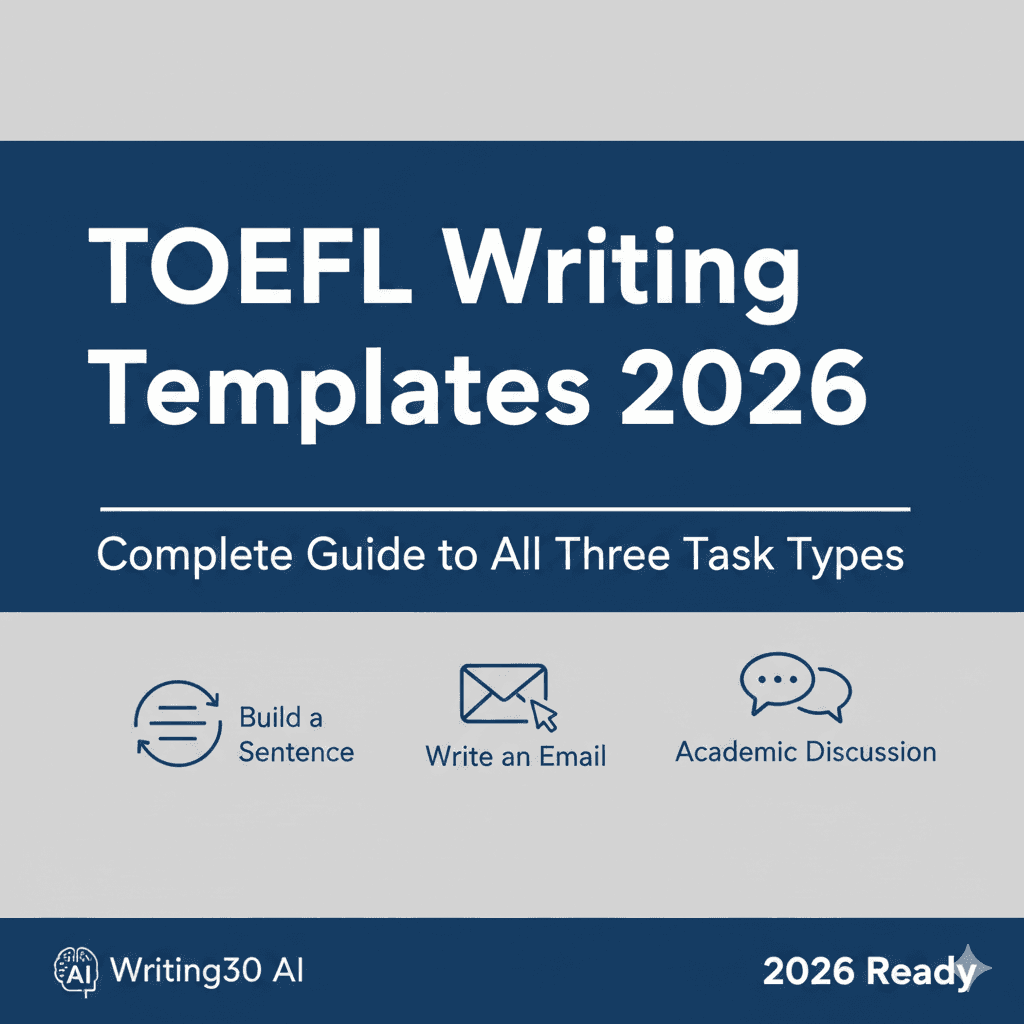
TOEFL 2026 Writing
Practice all three 2026 writing tasks
Build a Sentence, Write an Email and Academic Discussion — timed practice scored on the 0–5 rubric with the specific fixes for your response. Build a Sentence is free and unlimited; every account also gets 3 AI-scored writing responses to start, then one more each day, up to 10 in total across Write an Email and Academic Discussion.
See writing practice