
Writing Strategies
TOEFL Writing Score 24 Practice Plan: 2026 Task-by-Task Guide
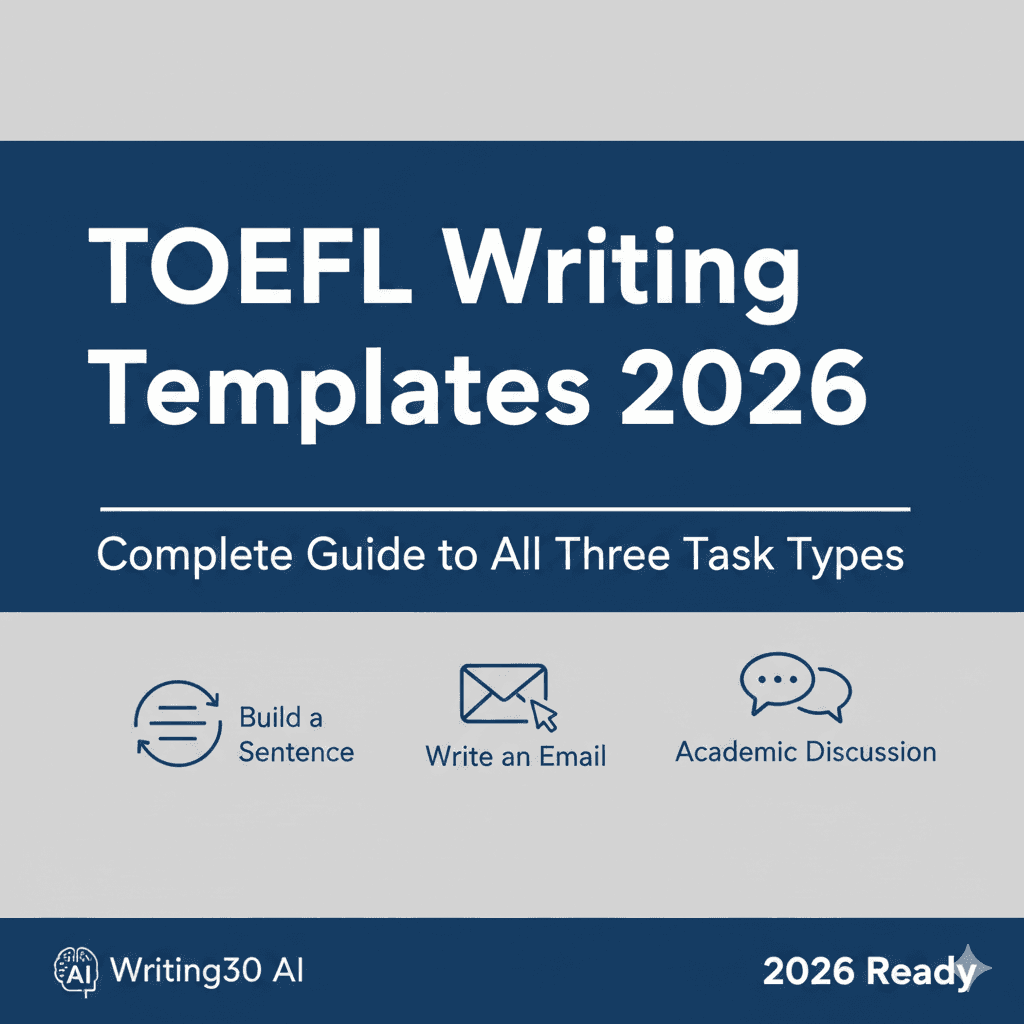
To achieve a TOEFL Writing score of 24 (pre-2026 0-30 scale; official 2026 reports use 1-6 bands), you need a structured practice plan focusing on the three tasks in the 2026 TOEFL Writing format: Build a Sentence, Write an Email, and Academic Discussion. This guide will outline a comprehensive weekly practice routine tailored to help you master each task, enhance your writing skills, and effectively prepare for the exam.
2026 TOEFL Writing Task Format and Timing
Understanding the format of the TOEFL Writing section is crucial for effective practice. The 2026 TOEFL Writing includes three distinct tasks, each with specific requirements and timing:
- Build a Sentence (~6 minutes): In this task, you will arrange a set of 6 to 12 words to form a coherent and grammatically correct sentence. The challenge lies in quickly synthesizing the words into a meaningful structure.
Example: Given the words "the cat on the mat sits," an acceptable arrangement could be "The cat sits on the mat."
- Write an Email (~7 minutes): This task requires composing an email of 80 to 120 words. The email should address a specific prompt, often involving a request or response to a question.
Example: If prompted to write an email to a friend about a recent trip, you might start with: "Hi [Friend’s Name], I just got back from my trip to the mountains. It was amazing!"
- Academic Discussion (~10 minutes): In this task, you will write a response of 100 to 150 words to an academic prompt, demonstrating your understanding of a topic and your ability to articulate your thoughts clearly.
Example: Responding to a prompt about climate change: "Climate change poses a significant threat to biodiversity. As temperatures rise, many species are unable to adapt quickly enough, leading to increased extinction rates."
Familiarizing yourself with these tasks and their respective timing is essential for effective practice and performance assessment.
Try it — write one response and have it scored
A real prompt from the question bank, scored by the same automated rater a signed-in learner gets. No account, no card, no email.
Discussion Topic
Mental Health in Universities
Mental health issues among college students have increased significantly in recent years. Universities face decisions about how much support to provide and who should bear the costs.
Professor's Question
Should universities be required to provide free mental health services to all students? What is your position?
No account, no card, no email. One scored response per day. Scores are produced by an automated rater against the ETS rubric and are Reach120 estimates, not official ETS scores.
Step-by-Step Weekly Practice Routine
To maximize your preparation for a TOEFL Writing score of 24, consider the following weekly practice plan. This routine emphasizes daily writing while allowing time for feedback and reflection.
Week 1: Familiarization and Basics
- Day 1: Focus on the Build a Sentence task. Practice with five different sets of words, aiming to arrange them correctly within the time limit.
- Day 2: Write emails based on different prompts. Choose at least three prompts and practice composing responses.
- Day 3: Engage with the Academic Discussion task. Write responses to two prompts, focusing on clarity and coherence.
- Day 4: Review your responses from Days 1-3. Identify common mistakes and areas for improvement.
- Day 5: Repeat the Build a Sentence task with new word sets.
- Day 6: Draft and review two new emails.
- Day 7: Write an additional Academic Discussion response and seek feedback from a peer or tutor.
Week 2: Increasing Complexity and Feedback
- Day 1: Focus on Build a Sentence again, but include more challenging word sets.
- Day 2: Write emails, but this time introduce more complex scenarios or requests.
- Day 3: Work on Academic Discussions with a focus on integrating examples and evidence.
- Day 4: Review all responses, this time checking for grammatical accuracy and style.
- Day 5: Combine tasks by creating sentences, writing emails, and drafting responses under timed conditions.
- Day 6: Engage in peer review. Exchange your work with a study partner and provide feedback.
- Day 7: Reflect on the feedback received and make revisions to your responses.
Week 3: Timed Practice and Mock Tests
- Day 1: Conduct a full mock test, including all three tasks under timed conditions.
- Day 2: Analyze your performance. Identify which task posed the most challenges and why.
- Day 3: Focus on the most challenging task for the entire day. Write multiple responses and seek feedback.
- Day 4: Practice writing emails and Academic Discussions based on real-life scenarios you might encounter.
- Day 5: Return to Build a Sentence. Aim for speed without sacrificing quality.
- Day 6: Review all tasks completed in the previous weeks and note improvements.
- Day 7: Rest and reflect on your progress. Prepare for the next week’s more intensive practice.
Week 4: Final Preparation and Review
- Day 1: Conduct a full mock test, ensuring to simulate test conditions as closely as possible.
- Day 2: Review performance and focus on specific weaknesses identified in the mock test.
- Day 3: Engage in intensive practice for the Build a Sentence task, focusing on speed and accuracy.
- Day 4: Write emails addressing different contexts, such as formal vs. informal situations.
- Day 5: Prepare for Academic Discussions by reviewing relevant topics and practicing writing concise responses.
- Day 6: Perform a final mock test and analyze your performance against the ETS rubric.
- Day 7: Rest, ensuring you are prepared mentally and physically for the exam day.
Common Mistakes and How to Fix Them
Understanding common mistakes in TOEFL Writing tasks is crucial for improvement. Here are some frequent issues and suggested solutions:
- Build a Sentence: Many test-takers struggle with grammatical accuracy.
Fix: Review sentence structure rules and practice identifying correct forms. For instance, "The dog barks loudly" is grammatically correct, while "Dog the loudly barks" is not.
- Write an Email: Under-developing the response — or rambling past the point — is a common error.
Fix: Track your length while you practice and aim for the 80-120 word target. Use a word processor with a word count feature, or count manually.
- Academic Discussion: Lack of clarity can hinder the effectiveness of your response.
Fix: Use topic sentences to introduce your main idea, followed by supporting details. For example: "Renewable energy is crucial for sustainable development. It not only reduces carbon emissions but also creates jobs in the green sector."
Regularly reviewing your mistakes and implementing these fixes will enhance your writing skills over time.
Sample Practice Prompts and Answer-Review Checklist
To help you practice effectively, here are sample prompts for each task along with a checklist for self-review:
Sample Prompts
- Build a Sentence: Arrange the following words into a correct sentence: "to the store went I yesterday."
- Write an Email: Write an email to your professor requesting clarification on an assignment.
- Academic Discussion: Discuss the impact of technology on education, focusing on both positive and negative aspects.
Answer-Review Checklist
- Clarity: Is the main idea clearly articulated?
- Grammar: Are there any grammatical errors?
- Structure: Is the response well-organized with a clear beginning, middle, and end?
- Word Count: Does the response meet the required word count?
- Relevance: Is the response relevant to the prompt?
Following this checklist will help you refine your skills and ensure you are ready for the test.
FAQ
What is the best way to practice TOEFL writing score 24 practice?
The best way to practice is by following a structured plan that includes daily writing tasks, seeking feedback, and regularly reviewing common mistakes.
How many TOEFL Writing tasks should I practice each week?
Aim for at least 3-5 tasks for each of the three writing types each week, ensuring you cycle through all tasks regularly.
How long should each TOEFL Writing practice session take?
Each practice session should last between 30 to 60 minutes, allowing time for writing and review.
Can I improve TOEFL Writing with free practice tasks?
Yes, many online resources offer free practice tasks. Utilize them to complement your study plan.
What score should I target before test day?
Aim for a score of 26 or higher in practice tests to ensure you have a buffer for potential test-day performance variations.
How should I review my TOEFL Writing mistakes?
Review your mistakes by categorizing them (e.g., grammatical, structural) and seeking feedback from knowledgeable peers or tutors.
What changed in the 2026 TOEFL Writing format?
The 2026 TOEFL Writing format now includes three specific tasks: Build a Sentence, Write an Email, and Academic Discussion, each with defined word counts and time limits.
When should I use timed practice instead of untimed practice?
Use timed practice as the test date approaches to simulate exam conditions. Initially, focus on untimed practice to build confidence and skill.
For more tips on improving your TOEFL Writing score, visit our blog or explore sample tasks to better understand the requirements and expectations.
Engage in consistent practice, seek feedback, and reflect on your progress to enhance your writing abilities and achieve your desired TOEFL score.
Next practice step
After reading this guide, practice one timed response on Reach120 and compare it with TOEFL sample answers. If you need the full current task breakdown, use the TOEFL Writing Practice 2026 guide.
Frequently asked questions
What is the best way to practice TOEFL writing score 24 practice?
The best way to practice is by following a structured plan that includes daily writing tasks, seeking feedback, and regularly reviewing common mistakes.
How many TOEFL Writing tasks should I practice each week?
Aim for at least 3-5 tasks for each of the three writing types each week, ensuring you cycle through all tasks regularly.
How long should each TOEFL Writing practice session take?
Each practice session should last between 30 to 60 minutes, allowing time for writing and review.
Can I improve TOEFL Writing with free practice tasks?
Yes, many online resources offer free practice tasks. Utilize them to complement your study plan.
What score should I target before test day?
Aim for a score of 26 or higher in practice tests to ensure you have a buffer for potential test-day performance variations.
How should I review my TOEFL Writing mistakes?
Review your mistakes by categorizing them (e.g., grammatical, structural) and seeking feedback from knowledgeable peers or tutors.
What changed in the 2026 TOEFL Writing format?
The 2026 TOEFL Writing format now includes three specific tasks: Build a Sentence, Write an Email, and Academic Discussion, each with defined word counts and time limits.
When should I use timed practice instead of untimed practice?
Use timed practice as the test date approaches to simulate exam conditions. Initially, focus on untimed practice to build confidence and skill.
TOEFL 2026 Writing
Practice all three 2026 writing tasks
Build a Sentence, Write an Email and Academic Discussion — timed practice scored on the 0–5 rubric with the specific fixes for your response. Build a Sentence is free and unlimited; every account also gets 3 AI-scored writing responses to start, then one more each day, up to 10 in total across Write an Email and Academic Discussion.
See writing practice