Reach120 Intelligence

What is actually running underneath

Four modelled components, the methods behind each one named, and the limits of each one published. Everything below describes code that runs in the product today.

Mistake Memory
Bayesian Knowledge Tracing across 16 modelled error types, fitted per learner.
Band Forecast
A gradient-boosted forecast, cross-validated on held-out learners.
Practice Router
Thompson-sampling adaptive routing that updates from what actually worked.
Glass Box
Deterministic engines compute every score, mastery value and recommendation; the language model only narrates them.

Reading and Listening are free on any account · Cancel any time

The learner model

Four components, and the method behind each one

The most intelligent way to prepare for TOEFL 2026. That is a strong sentence, so here is what is underneath it — the method, and what was actually fitted, for each of the four.

  1. 01

    Mistake Memory

    Bayesian Knowledge Tracing, per learner, per error type

    Each error type is a latent skill with its own learn, slip and guess rates. Every scored response is an observation, and your mastery estimate for that error type moves accordingly — so a mistake you make once and never repeat separates itself from the one that keeps costing you points.

    What is fitted: 16 error types cleared the ≥30-sequence bar over 984 sequences; the rest are pooled into one fallback skill rather than fitted on too little data.

  2. 02

    Band Forecast

    A gradient-boosted regressor on your recent practice

    The features are your last three scores, an exponentially weighted average, how many sessions you have done, how long since the last one, which task family you are about to attempt, and your recent error rate. It estimates the band your next session is heading for — not a test-day result.

    What is fitted: 5-fold cross-validation grouped by user, so no learner appears in both train and test: 1125 sessions from 98 learners.

  3. 03

    Practice Router

    Thompson sampling over task arms

    Each task family carries a posterior over how much score movement it tends to produce. The router draws from those posteriors and adds a bonus for the skills your own mastery estimates say are weakest, so two learners on the same band can be sent to different next tasks.

    What is fitted: 88 observed Writing outcomes across the three writing arms. Reading and Speaking are routed by deterministic per-learner rules instead — see the limits below.

  4. 04

    Glass Box

    Deterministic computation, narrated afterwards

    Scores, mastery values, readiness and the next-task choice are all computed in code. The language model is handed those finished facts and asked only to write them up, and its text is checked against them before you ever see it.

    What is fitted: A narration containing a number, a pattern label or a route that is not in the computed facts is discarded rather than shown, and the writer returns nothing at all if the check fails.

Both fitted artefacts date from July 10, 2026. Reading and Speaking are routed by deterministic per-learner rules rather than by the sampler — the limits below say exactly where each method does and does not apply.

Method transparency

Where the model is weak, in our own words

The forecast beats the naive baselines — 0.40 mean absolute error against 0.75 and 0.64 — and it is still about half a band out. Everything else we know to be a limitation is listed here rather than left for you to find.

The forecast is accurate to about half a band

Cross-validated mean absolute error is 0.40 on the 0-5 rubric scale, against 0.75 for "assume your previous score" and 0.64 for "assume your average". That is a real gap, and it is still about half a band of typical error. It is good enough to point your study at a section. It is not good enough to plan a test date around.

Part of the forecast is a task prior, not a read on you

Some of the model's advantage over "assume your previous score" comes from knowing which task family you are about to attempt, because task families score differently. That is legitimate for "what is your next Academic Discussion heading for", but it means the model is partly a calibrated per-task prior rather than a purely personal one.

One of its inputs is currently dead

The word-count feature contributes nothing: word counts are missing on almost every historical rubric session, so the model effectively ignores it. It is listed here rather than removed because the backfill is the fix, and until then the feature list overstates what is being used.

Four error types have weakly identified learning rates

Punctuation, plural forms, word choice and capitalization have too few and too short sequences to pin down. Read their fitted transition rates as "this error rarely comes back" rather than as a calibrated speed of learning. The guess-rate ceiling also binds on most skills, which flattens differences between them.

The router adapts in two sections, not four

Thompson sampling runs in Writing and Listening. Reading and Speaking are routed by deterministic per-learner rules over your own weakest skills — still personal, but not adaptive in the same sense. And only Writing has enough settled outcomes for the posteriors to have moved off their priors.

What the router has learned is learned from everyone

The posteriors are population-level: one shared set of arm estimates, not a model fitted to you. Your own contribution is the mastery bonus and the draw, which is what makes two learners diverge. Nobody should read this as "a model trained on your data alone".

These are practice estimates, not scores

Open responses are judged by an AI model against criteria we wrote from publicly available task descriptions. They are not ETS rubrics, the model is not trained on officially scored responses, and a judgment can be wrong. Reading and Listening are the exception: those are graded against the answer key.

The numbers on this page have a date

Both fitted artefacts date from July 10, 2026 and are refitted as more practice accumulates, so these figures move. They are published as of the last refit rather than as a standing property of the product.

Every section

What each section holds, and what comes back

All four TOEFL 2026 sections in one account, writing to one learner record. Each card names the task families in the bank and what a submission actually returns.

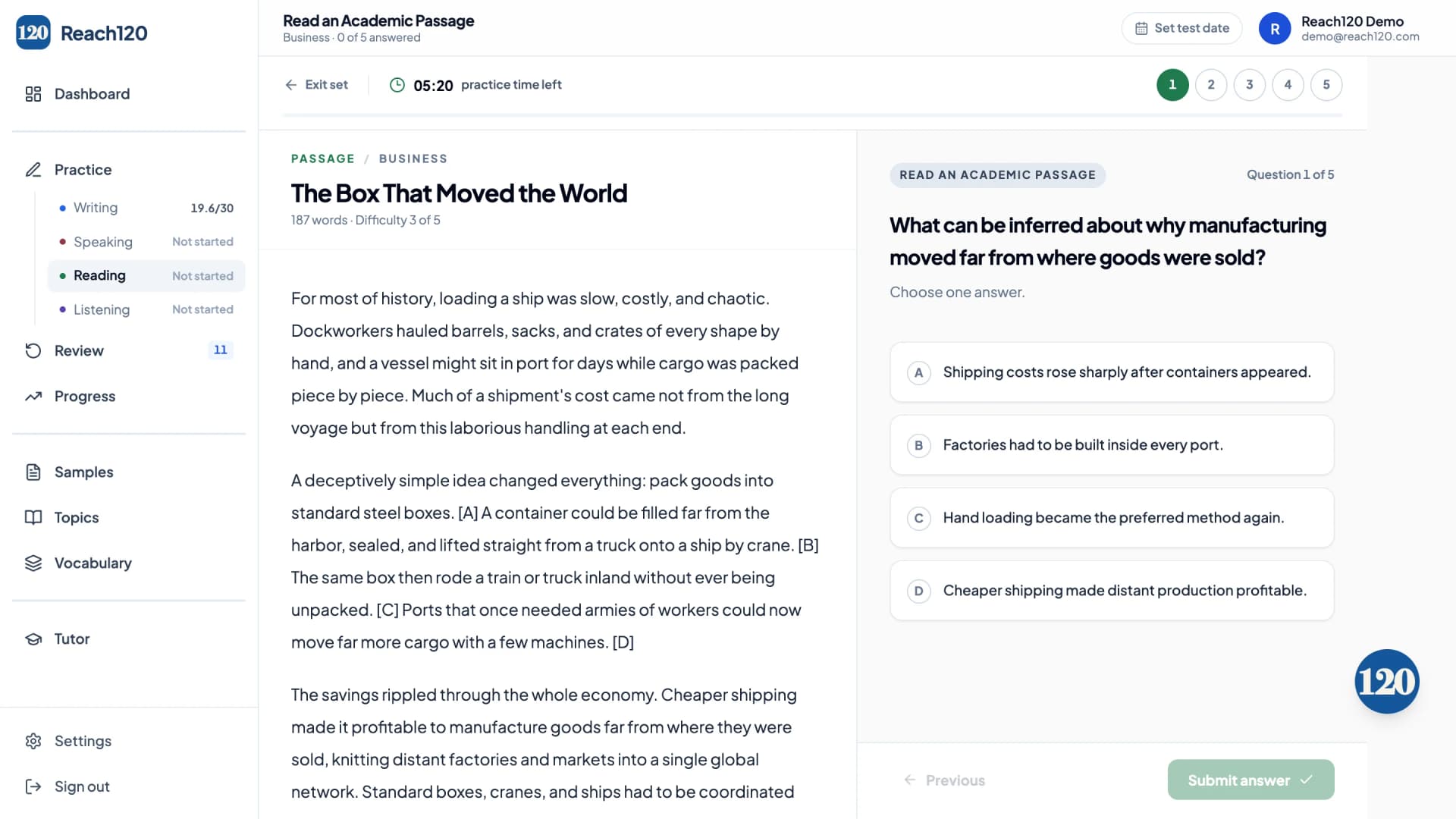
Reading

Task families

  • Academic passages and daily-life texts in the 2026 item formats
  • Vocabulary in context
  • Insert a sentence
  • Evidence and detail questions

What you get back

  • Per-item result the moment you submit, with the key and why the right answer is right
  • Per-skill accuracy so a comprehension habit separates from a vocabulary gap
  • Every missed item becomes a scheduled review card

Graded against the answer key. No model judges a Reading item.

Open Reading
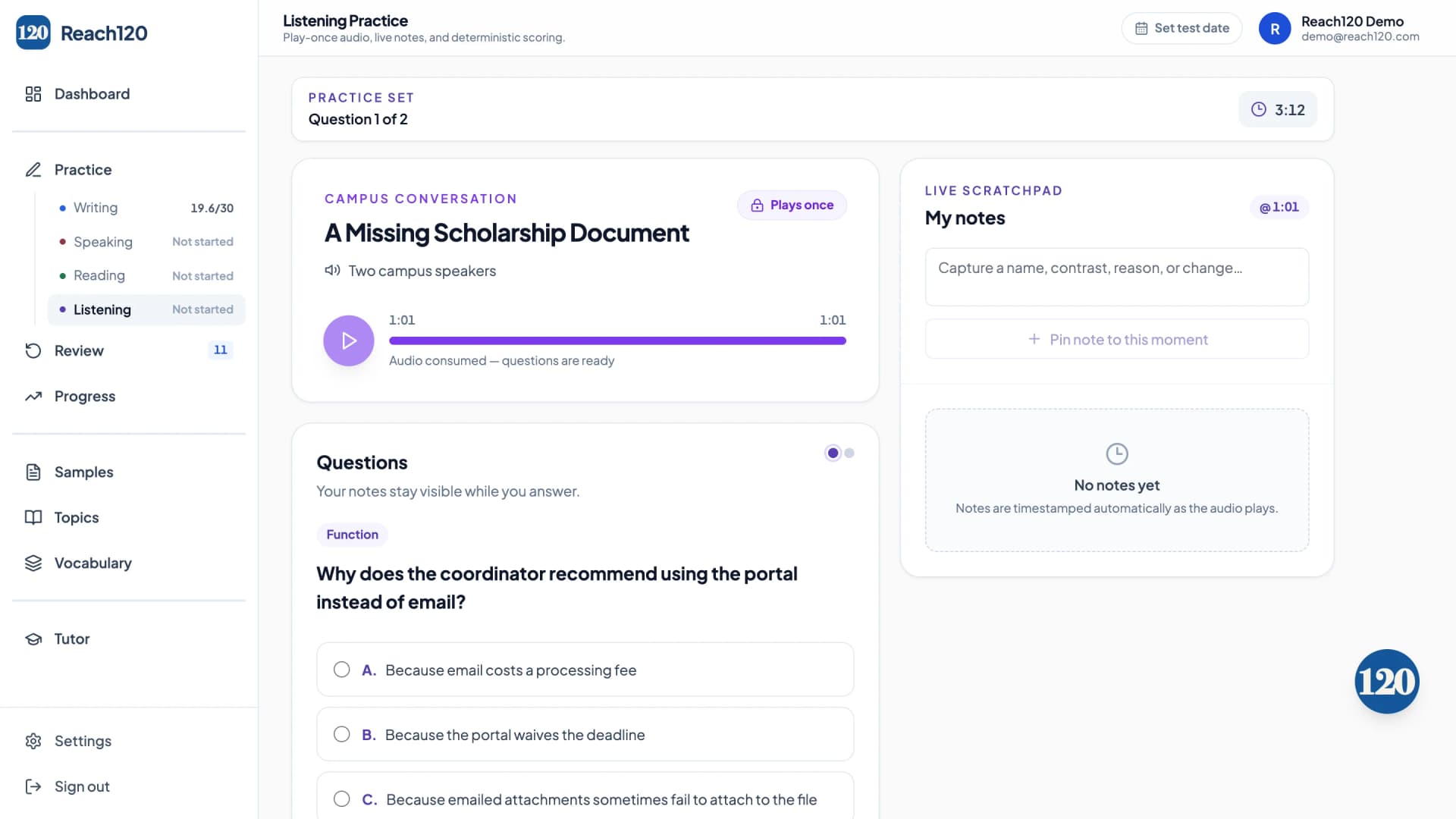
Listening

Task families

  • Campus conversations and announcements
  • Academic talks and lectures
  • Play-once audio, exactly like test day

What you get back

  • Questions stay locked until the audio ends, so you practise the real memory load
  • A timestamped scratchpad you write in while the audio runs
  • Diagnostics per listening skill — gist, detail, attitude, function, inference, organization

Graded against the answer key, per question.

Open Listening

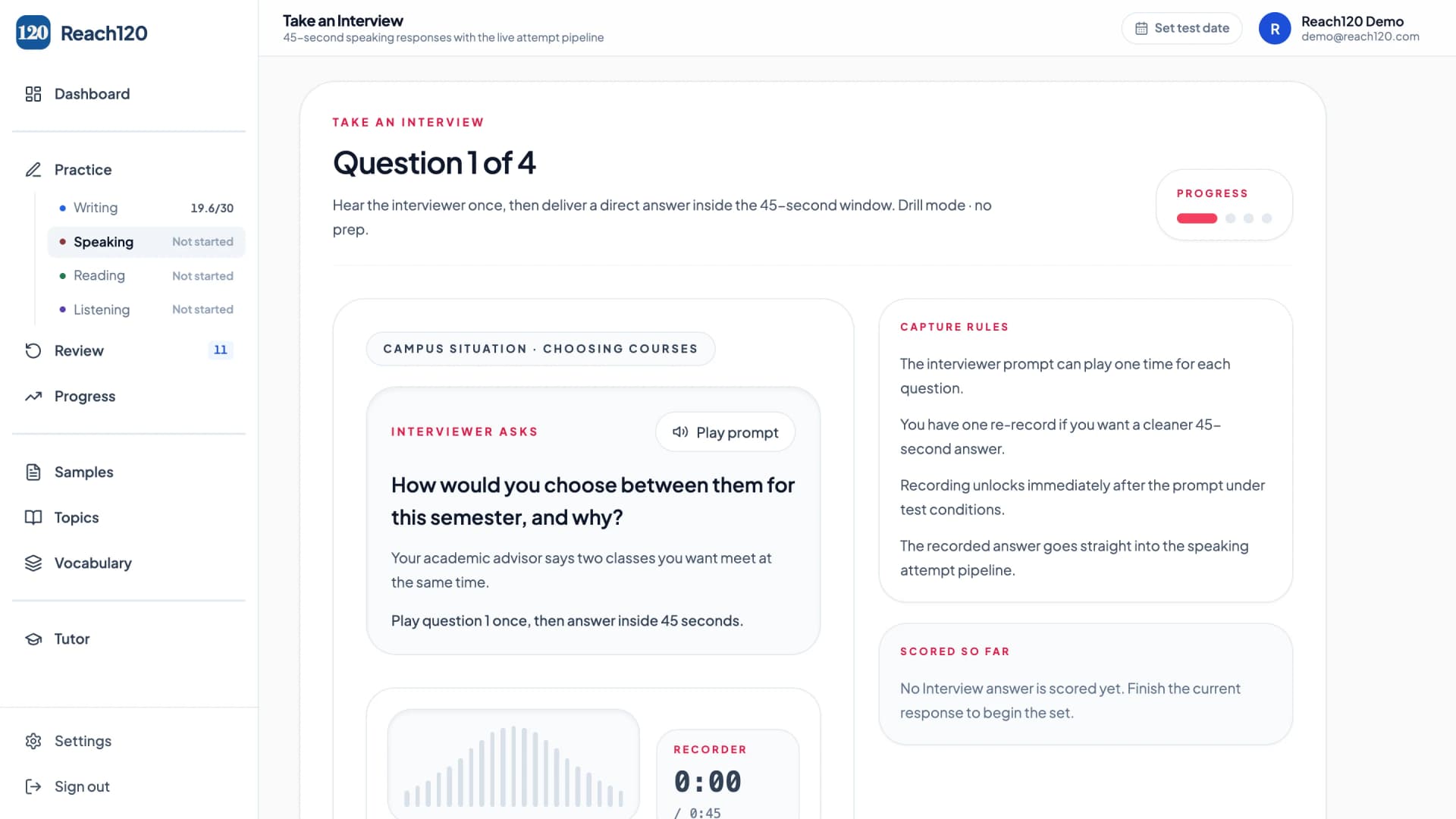
Speaking

Task families

  • Listen and Repeat
  • Take an Interview — campus interview questions answered aloud
  • A 45-second response window on the clock

What you get back

  • Your answer transcribed, so you can read what you actually said
  • Delivery measured: words per minute, pauses, fillers
  • Language use and topic development scored separately, each with the next lift
  • A downloadable speaking report

Transcribed automatically, then judged by an AI model against our criteria.

Open Speaking

Writing

Task families

  • Build a Sentence — arrange the given words
  • Write an Email
  • Academic Discussion

What you get back

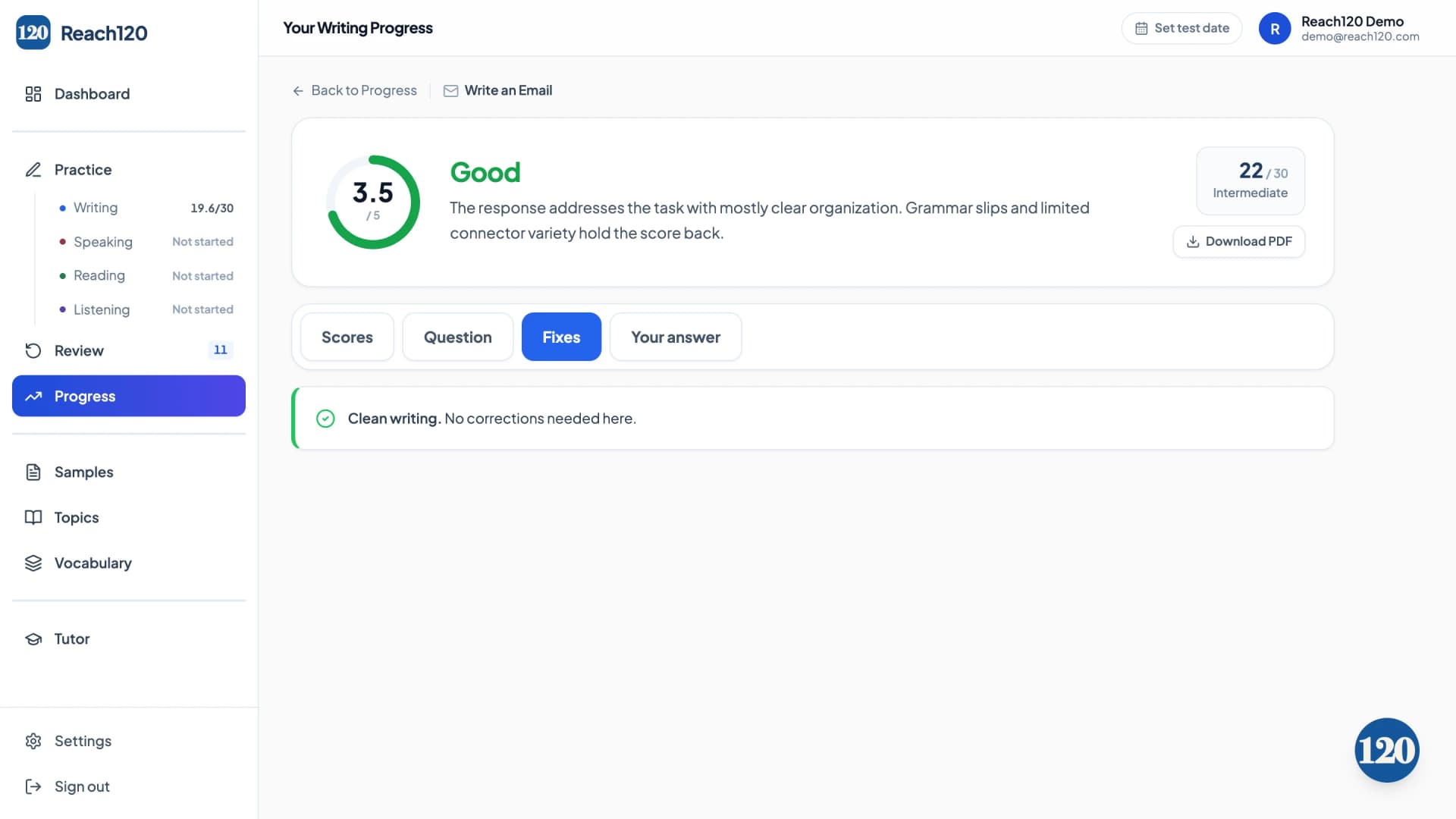
  • A rubric-based practice estimate with the per-dimension breakdown
  • Your own mistakes highlighted in your own text, by error type
  • One Score Higher — your response rewritten one band up, in your words
  • Corrections become spaced review cards you re-fix later

Build a Sentence is matched against the accepted arrangement and is not judged. Email and Academic Discussion are judged by an AI model against our criteria.

Open Writing

Scoring truth

Which number is which, and where it comes from

Every score-shaped figure in Reach120 carries the same label: reach120 practice band estimate — not an official ets score. This is what sits behind that sentence.

Official reporting is 1–6, in half-band steps
Since January 21, 2026, official ETS score reports use bands in 0.5 increments. Reach120 leads with a band everywhere for that reason, so what you watch move is the thing your report will show.
Open responses are scored on a 0–5 rubric
Write an Email and Academic Discussion return a 0–5 rubric estimate per dimension. That is the raw scale those tasks are judged on, and it is the number the feedback is attached to.
The /120 figure is a legacy comparison
A number out of 30 per section, or out of 120 overall, is the pre-2026 scale. Reach120 keeps it because so much study material still uses it, and labels it as a comparison estimate every time it appears. It is not the current official format.
Build a Sentence is counted, not judged
Your arrangement either matches an accepted answer or it does not, so no model decides the result. The 2026 specification publishes a maximum of one point per item; scoring each item as simply right or wrong is our reading of that allocation, not a rule ETS has stated.
Reading and Listening are graded against the key
Those two sections are deterministic end to end. Their results are exact rather than estimated, and because no model is called, an attempt costs nothing to serve — which is why they are uncapped on a free account while the two AI-scored sections carry a daily allowance.
Length targets are ours, not ETS rules
ETS publishes no word-count requirement for Write an Email, and states that an effective Academic Discussion response is at least 100 words with no published maximum. Any range Reach120 shows is an optional pacing target for practice, and no response is ever marked down for going past one.
Read how scoring works in full

The whole test in one sitting

A four-section mock, run in the 2026 order

Reading, then Listening, then Speaking, then Writing — back to back, on the clock, in one session that you cannot cherry-pick your way through. The listed blueprint runs 1 h 23 min – 1 h 29 min.

Sections run in order, each on its own timer

You cannot skip ahead or return to a finished section. The run is what produces a comparable score across all four rather than four good days stitched together.

Scored section by section, then read as one test

Each section returns its own result on the same practice-estimate scale, and the run writes to the same learner record as your ordinary practice — so the model sees you under test conditions too.

You can leave and come back

The run is stored server-side as it goes, so a closed tab or a dead battery does not cost you the whole mock.

Open the full mock

Listed blueprint times, shown as estimates — ETS states the 2026 specification is subject to minor revision until launch.

Vocabulary and spaced review

Your own mistakes and your own words, on one schedule

Missed items and generated vocabulary cards are aged by the same spaced-repetition scheduler, so a word you half-know and an error you keep repeating come back at the right moment instead of whenever you happen to remember them.

One scheduler, not two

Mistake review and vocabulary review share a single FSRS implementation targeting 90% recall, so a card and a past error age at the same rate and can be counted in one due number.

Decks on the topic you actually need

Generate a deck for any topic — a field you keep reading about, a task type you keep losing points on — with each entry carrying its meaning, its use and a worked example.

Reviewing is never taken away from you

Generation is what is capped, because generation calls a model. Once a deck exists it is yours to review for as long as you like, on any account. Free accounts can generate 1 deck.

Progress analytics

A score sheet, not a streak counter

Readiness per section, the trend under it, the skills that are moving and the ones that are not — presented as an estimate with its own uncertainty rather than as a number that flatters you.

Sections you have not practised stay unmeasured

An unpractised section is shown as unmeasured, never counted as a zero. A readiness figure built by averaging in silence would be the easiest number on the page to fake.

Every score-shaped number says what it is

Practice estimates are labelled as estimates and carry a link to how they were produced. Failed reads render as named unavailability rather than as a confident zero.

The forecast stays blank until it means something

Typical error is about half a band, so it is a study signal — not a predicted TOEFL score. With too little history it returns nothing at all rather than an invented figure.

For tutors

Run a whole class from one workspace

Reach120 does not replace you — it does your marking. The workspace exists so class time goes to teaching instead of correcting grammar between lessons.

Classes students join three ways

A private invite link, a short class code they type themselves, or a QR code you put on the screen in front of them. No account provisioning, no spreadsheet of names to upload.

Assignments with due dates

Publish a task to the whole class, watch completion move as work comes in, and see what is still outstanding without asking anyone.

The response, not just the number

Open the full feedback report behind any submission — what the student actually wrote or said, the per-dimension breakdown, and the fixes.

Present mode for the room

Put the class code, a task, or a piece of work on a projector at a size a room can read, without exposing anything a student has not agreed to share.

Consent is the access model

A student sees the exact access list before joining and can leave whenever they want. It is not a policy sitting on top of a broader permission — it is what the endpoints will return.

Each student holds their own account

Students buy their own pass and own their own practice record. Nothing about a class transfers ownership of a learner’s work to the person teaching them.

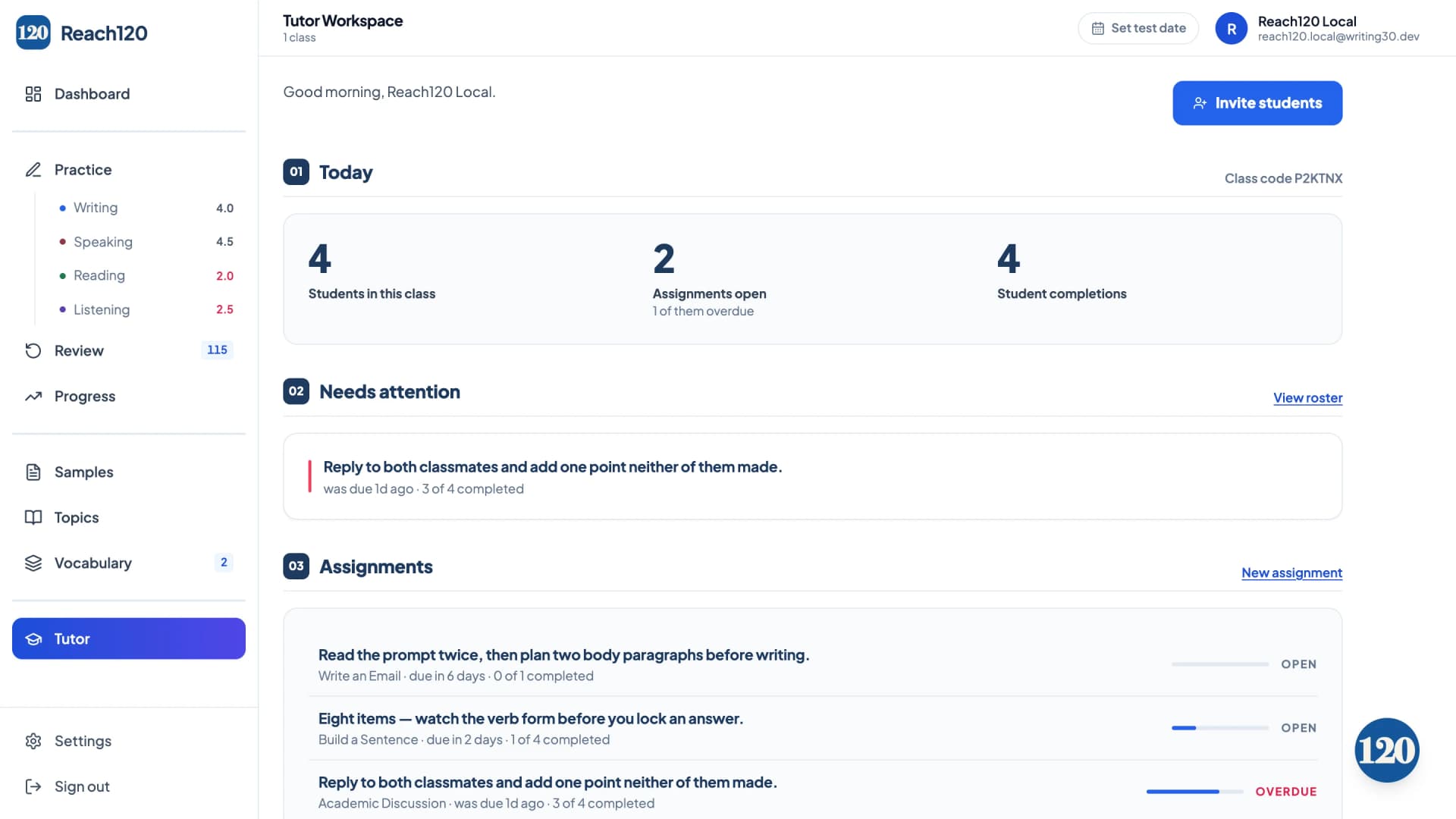
The Reach120 tutor workspace: today's class code, how many students are in the class, how many assignments are open and how many have been completed, the work that needs attention, and the published assignments with their due dates and progress.
The workspace itself, not a mockup. What a teacher sees is bounded by what each student agreed to: scores and rubric feedback on practice you complete, submission history and pdf feedback reports, assignment progress and activity — and nothing else.
How students join — and what we don't claim

PDF feedback reports

A report you can hand to somebody

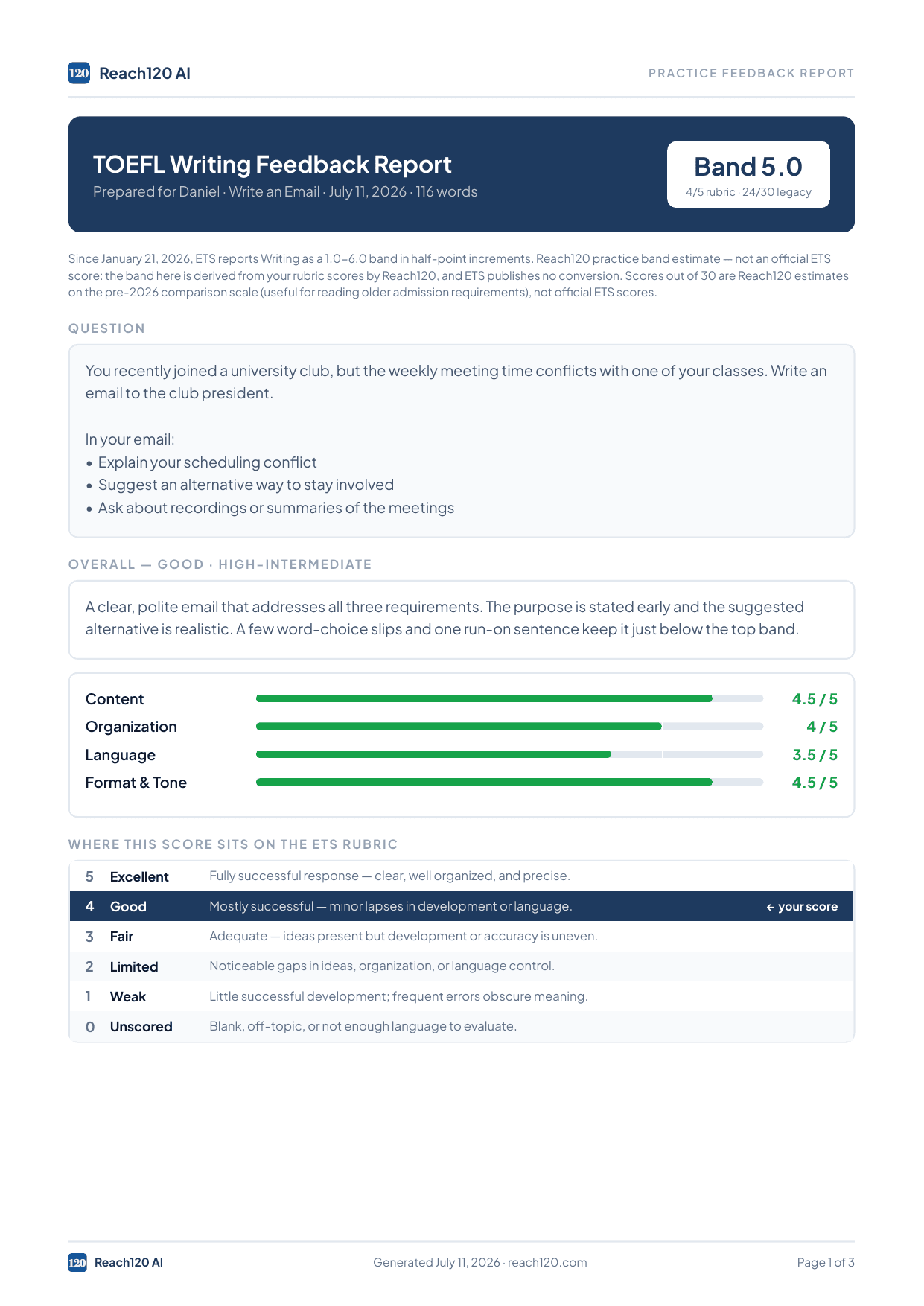
Every scored writing and speaking attempt can be downloaded as a typeset report — a purpose-designed document rather than a screenshot of the app — which is the artefact a learner takes to a teacher, a parent or an application file.

The whole attempt, not just the number

The band estimate with its label, the per-dimension breakdown, the specific fixes, and your own response — so the reader can check the judgment instead of taking it.

Generated on your device

The document is rendered in your browser from the feedback you already have. Your response is not sent anywhere new to produce it.

Written to be read by a teacher

Speaking attempts get their own report shape, and both carry the same estimate labelling as the app, so nothing becomes an official-looking score once it leaves the screen.

Privacy and consent

What is kept, who can see it, and how you leave

A model that remembers your mistakes is a model that stores them. Here is exactly what that means, including the parts that are inconvenient to say.

What the learner model stores

Your responses, the scores and feedback they produced, the error types found in them, and the review cards scheduled from those errors. That record is what makes the model personal — there is no version of it that both remembers your mistakes and keeps none of them.

A tutor sees exactly what you agreed to

Joining a class shows you the access list before you accept, not after. You can leave a class whenever you want, and your work stops being visible when you do.

  • Scores and rubric feedback on practice you complete
  • Submission history and PDF feedback reports
  • Assignment progress and activity

And nothing outside it

These are not policy promises layered over a broader permission — they are the boundary of what the class endpoints will return at all.

  • Your password, email inbox, or login details
  • Billing, subscription, or payment information
  • Your chat history with the Reach120 assistant

You can take your account back

Cancelling leaves your access running to the end of the period you paid for. Deleting the account is self-service and removes your practice record with it — you do not have to email anyone to leave.

The boundary

What Reach120 is not

Six things this product does not do. They are on the page rather than in a footnote because knowing where a tool stops is the only way to judge whether it is the right one.

  • Not official ETS material

    Reach120 is independent. Nothing here is published, licensed, endorsed or reviewed by ETS, and no question in the bank is a real test question. TOEFL is a registered trademark of its owner, used here only to say which test we prepare you for.

  • Not an official score

    Every number Reach120 shows is a practice estimate produced by our own methods. It is a way to track your own movement over time. It does not predict, convert to, or stand in for an official result.

  • Not a promise about your result

    No tool can promise you a particular band, and we will not pretend otherwise. What practice produces depends on the practice you do — anyone selling you the other version of that sentence is selling you something they cannot deliver.

  • Not a substitute for your teacher

    Reach120 does the marking. It does not do the teaching, it cannot see why you are stuck, and it cannot decide what you should do about your life. If you work with a teacher, this is the thing that fills the days between lessons.

  • Not a course

    There is no lecture series, no grammar syllabus from scratch, and no beginner track. Reach120 assumes you can already write and speak English and are trying to score better on a specific test.

  • Not a human reader

    Open responses are judged by a model against criteria we wrote. It is fast, consistent and available at midnight, and it is not a person reading your work. Where the result matters, read the feedback rather than the number.

Reach120 practice estimates are study aids for tracking your own progress. They are not official ETS scores and do not predict one.

Still the right tool?

Reading and Listening are free on any account, so you can check the scoring against your own judgment before paying for anything.