TOEFL Tips
TOEFL 2026 Build a Sentence: Tips for Perfect Scores
The Build a Sentence task may seem simple, but English word order can be tricky. One misplaced word means zero points. Master these patterns and strategies to arrange words correctly every time on the TOEFL 2026. This is the first of three tasks in the new format - see our complete templates guide for all three. (See the visual summary infographic at the end for a quick reference.)
Watch: English Word Order Mastery
Learn how to arrange words in the correct order to form grammatically correct sentences
Try it — write one response and have it scored
A real prompt from the question bank, scored by the same automated rater a signed-in learner gets. No account, no card, no email.
Discussion Topic
Generational Differences in Work
Media often portrays different generations as having distinct work ethics and values. Researchers debate whether these differences are substantial.
Professor's Question
Are generational differences in work attitudes (Baby Boomers vs Millennials vs Gen Z) real and significant, or are they exaggerated?
No account, no card, no email. One scored response per day. Scores are produced by an automated rater against the ETS rubric and are Reach120 estimates, not official ETS scores.
What is Build a Sentence?
Build a Sentence is a task type introduced with the TOEFL 2026 format[1]. You'll see a context sentence and a question, then receive a set of scrambled words and phrases to arrange into a grammatically correct answer[2]. The ETS 2026 test specifications list 10 Build a Sentence items in the Writing section; they do not publish how many word elements a single item carries, so treat any "6-8 words per item" figure as an observation from published examples rather than a rule. Mastering word order is critical for success on this task.
Task Format
1. Context Sentence
"What was the highlight of your trip?"
2. Scrambled Words
3. Your Answer
"The tour guides who showed us around the old city were fantastic."
Important: No Partial Credit!
Each Build a Sentence item is scored correct or incorrect—there's no partial credit[1]. If even one word is in the wrong position, you get zero points. But when you get it right, you get full credit. Accuracy is everything.
The 4-Step Strategy for Build a Sentence
Follow this systematic approach for every item. With practice, it becomes automatic.
Find the Subject
Look for nouns or noun phrases that could be the "doer" of the sentence. Common subjects include: the tour guides, students, I,the problem. The subject usually comes first.
Identify the Main Verb
Find the verb that goes with your subject. Check agreement: plural subject needs plural verb (guides were), singular subject needs singular verb (guide was). The verb comes right after the subject (unless there's a relative clause).
Look for Relative Clauses
Words like who, which, that signal a relative clause. This clause goes right after the noun it describes. Example: "tour guides who showed us around."
Place Modifiers & Complements
Add remaining pieces: prepositional phrases (in the old city), adjectives (fantastic), and adverbs. Adjectives go before nouns or after linking verbs. Prepositional phrases usually go at the end.

Master word order patterns to ace the Build a Sentence task
Strategy in Action
- Subject. The tour guides ...
- Wait — there's a relative clause. The tour guides who showed us around the old city ...
- Main verb (plural subject = "were"). The tour guides who showed us around the old city were ...
- Complement (adjective after "were"). The tour guides who showed us around the old city were fantastic.
Essential English Word Order Patterns
Master these patterns and you'll know where every word belongs. English is an SVO (Subject-Verb-Object) language with consistent modifier placement rules[3][4]. Understanding English sentence structure[5] is fundamental to the Build a Sentence task.
Pattern 1: Basic SVO
Subject + Verb + Object/ComplementStudents need support.
The tour guides were fantastic.
I like your magazine.
Pattern 2: Relative Clauses (who/which/that)
Noun + who/which/that + verb phrase + main verbThe guides who showed us around were helpful.
The problem that I experienced was frustrating.
The magazine which features poetry is new.
Pattern 3: Adjective Placement
Before noun: The fantastic guidesAfter linking verb: The guides were fantasticThe old city was beautiful.
The city was old and beautiful.
Pattern 4: Adverb Placement
Frequency adverbs: Subject + adverb + verbManner adverbs: Verb + object + adverbStudents always need support. (frequency)
She explained the problem clearly. (manner)
I really like your magazine. (degree)
Pattern 5: Prepositional Phrases
Usually at the end: Subject + verb + object + prep phraseThey showed us around the old city.
I had a problem with the form.
The concert starts at 8 PM.
Practice Examples
Try these examples to test your understanding. Think about the structure before revealing the answer.
Example 1
Context: "How do you feel about your new job?"
Reveal Answer
"I really enjoy the challenging work."
Structure: Subject (I) + adverb (really) + verb (enjoy) + object (the challenging work)
Example 2
Context: "What did you think of the restaurant?"
Reveal Answer
"The food that we ordered was delicious."
Structure: Subject (the food) + relative clause (that we ordered) + verb (was) + complement (delicious)
Example 3
Context: "What makes this university special?"
Reveal Answer
"It always provides research opportunities for students."
Structure: Subject (It) + adverb (always) + verb (provides) + object (research opportunities) + prep phrase (for students)
Example 4
Context: "How was your experience with the customer service?"
Reveal Answer
"The representative who assisted me was very helpful."
Structure: Subject (the representative) + relative clause (who assisted me) + verb (was) + adverb + complement (very helpful)
Score your own writing free — no account
Answer one Academic Discussion prompt and read the full report: estimated band, every rubric dimension and the specific fixes.
Tricky Structures to Watch
These patterns often trip up test-takers. Watch out for them!
Watch Out: Subject-Verb Agreement with Relative Clauses
Wrong
"The guides who showed us around was fantastic."
Correct
"The guides who showed us around were fantastic."
Tip: The main verb agrees with the main subject (guides = were), not the relative clause subject.
Watch Out: "Very" Placement
Wrong
"I very much like your magazine."
Correct
"I like your magazine very much."
Tip: "Very much" goes after the object, not between subject and verb.
Watch Out: Frequency Adverb Position
Wrong
"Always students need support."
Correct
"Students always need support."
Tip: Always, often, never, usually go AFTER the subject and BEFORE the main verb.
Watch Out: Multiple Modifiers Before Nouns
Tricky
"The old city tour guides"
Correct
"The tour guides in the old city"
Tip: When modifiers are complex, use a prepositional phrase after the noun.
Deepen Your Understanding
To develop a stronger foundation in English word order and sentence structure, explore these authoritative resources:
Quick Tips for Test Day
Don't rush
About 35-40 seconds per item across the 10 items. Think before clicking.
Find the subject first
Every sentence starts with who/what is doing something.
Check agreement
Plural subjects need plural verbs. Match them.
Watch for 'who/which/that'
These signal relative clauses that go right after nouns.
Read the context
The context question tells you the expected answer type.
Say it in your head
Does it sound natural? If not, something's wrong.
Look for extra words
Sometimes there's a distractor word you don't need.
Move on if stuck
Don't spend 3 minutes on one item. Skip and return.
Time Management
A Reach120 pacing target, not an ETS rule — ETS publishes only the 23-minute figure for the whole Writing section.
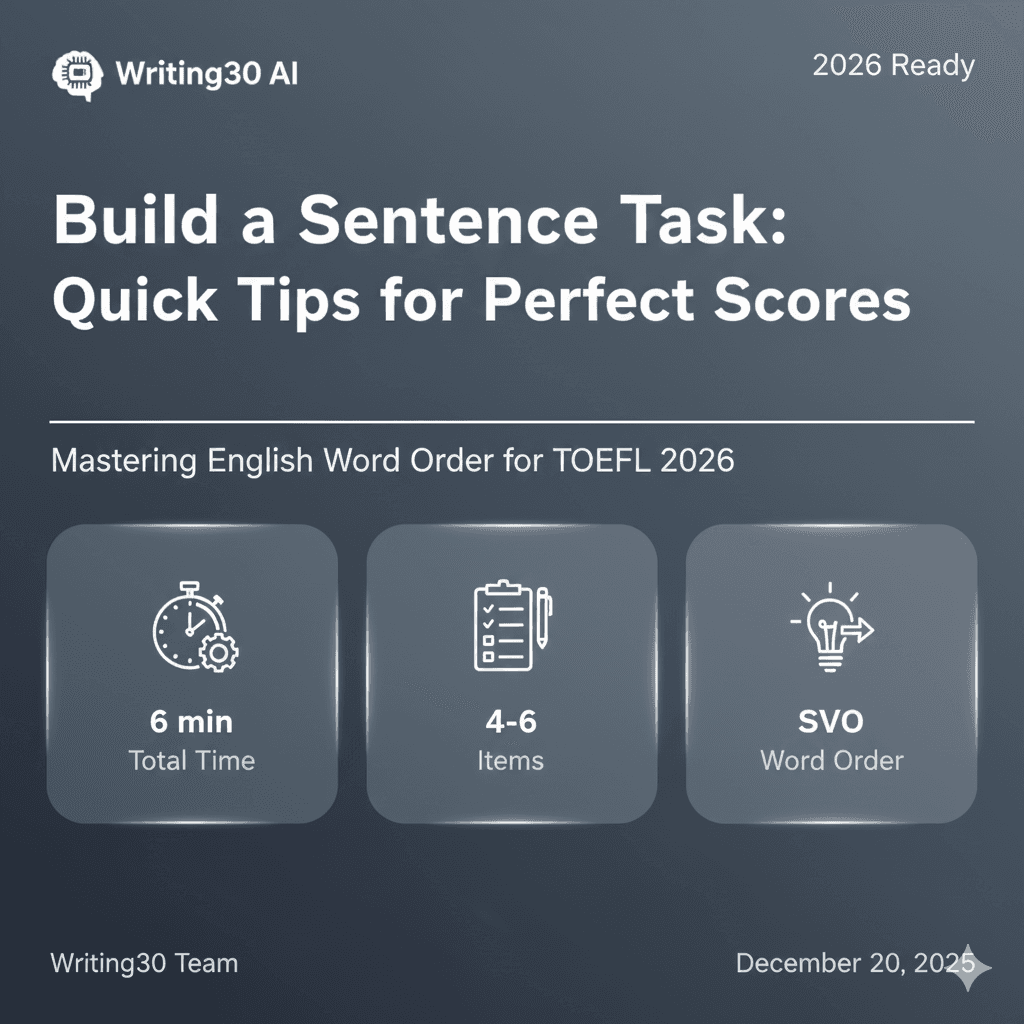
Visual Summary: Build a Sentence Task at a Glance
Save or bookmark this infographic for quick reference when practicing. It summarizes all the key strategies, grammar patterns, and tips covered in this guide.
Guides for Other TOEFL Sections
References & Further Reading
- 2026 TOEFL Format Revealed — TOEFL Resources Blog (Accessed: December 2025)
- TOEFL iBT Test Content and Structure — ETS Official Website (Accessed: December 2025)
- Word Order in English — BoldVoice English Learning (Accessed: December 2025)
- English Syntax: Subject-Verb-Object Explained — StudySmarter English Explanations (Accessed: December 2025)
- English Sentence Structure Guide — Oxford Online English (Accessed: December 2025)
- TOEFL iBT Writing Section Updates 2026 — ETS TOEFL Preparation (Accessed: December 2025)
External links open in a new tab. Reach120 is not affiliated with the linked sources.
Frequently asked questions
What is the Build a Sentence task on TOEFL 2026?
Build a Sentence is a task type on the TOEFL 2026 writing section. You are given a context sentence and a set of scrambled words and phrases, and you arrange them into a grammatically correct answer. The ETS 2026 test specifications list 10 Build a Sentence items in the Writing section. ETS does not publish how many word elements an individual item carries, so any per-item word count quoted elsewhere is an observation rather than a specification value. Each item is scored correct or incorrect with no partial credit.
How is Build a Sentence scored?
Build a Sentence uses dichotomous scoring: each item is either correct (1 point) or incorrect (0 points). There is no partial credit. If your word order is grammatically correct and answers the prompt question appropriately, you get full credit. If any word is misplaced, you get zero points for that item.
What grammar is tested on Build a Sentence?
Build a Sentence tests: 1) Subject-verb agreement, 2) Word order (SVO pattern), 3) Relative clauses (who, which, that), 4) Adjective and adverb placement, 5) Prepositional phrases, 6) Verb tense and modals, 7) Article usage. The task directly measures English syntactic competence.
How long do I have for each Build a Sentence item?
ETS publishes only a section-level time: about 23 minutes for the whole Writing section. Spending roughly 6 of those minutes across the 10 Build a Sentence items leaves about 35 to 40 seconds per item. That per-task split is a Reach120 pacing estimate, not an ETS rule. Budget around 20 seconds to identify the structure and 15 to arrange the words, and move on rather than stalling on one item.
TOEFL 2026 Writing
Practice Build a Sentence
Drag-and-drop word-order questions in the 2026 format, marked as you go, so you can see which patterns are costing you points instead of guessing.
Practice Build a Sentence